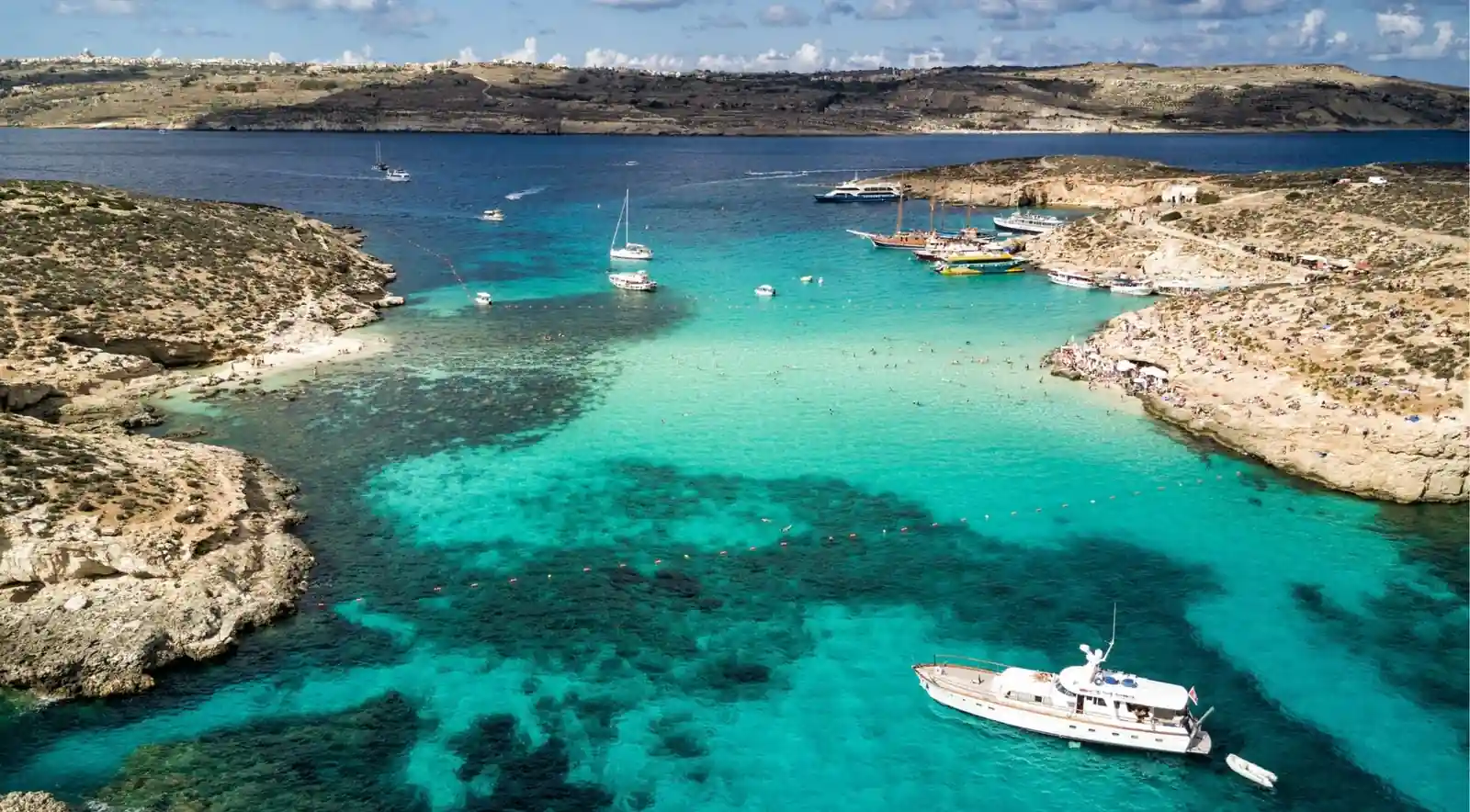
The short answer
Most Blue Lagoon boat trips run from spring through autumn. Some cruises continue through winter, but departures are more limited and seasonal swim stops such as the Crystal Lagoon become photo stops. For choosing a month, what changes is the sea, the weather, the crowds and which swim stops run. On the day itself, wind and sea conditions may cancel or reroute a trip, and individual swim stops may be skipped at any time of year.
If your dates are flexible, September offers the best overall balance for swimming. The sea is around 26°C, visitor numbers across Malta have dropped from the August peak, and the main summer trips are still running. August has the warmest water, July and August offer the widest choice of trips, and both are busy months for visitors to Malta. June is another strong choice, with comfortable water at about 22°C, very little rain and fewer visitors to Malta than the August peak. October still has warmer water than June, at about 24°C, but the weather becomes less reliable as autumn progresses.
For fewer people at the lagoon itself, take an early departure, or a sunset cruise in summer, rather than arriving in the middle of the day. If your tour allows you to go ashore, check that you have the correct free Blue Lagoon landing pass for your time slot. Cruises that run through winter are better treated as sightseeing trips than swimming trips, with the sea around 16°C in January and February.
- Best overall for swimming
- September
- Warmest sea
- August
- Widest choice of trips
- July and August
- Warm sea, fewer visitors than peak summer
- June and September
- Quieter shoulder season
- May and October
- Fewer people, day cruise
- First departure of the morning
- Sunset cruise
- June to September
- Winter
- Sightseeing, not swimming
- Most important live checks
- Wind, gusts and wave height
- Sea temperature, September 26.3°C
- Sea temperature, June 22.4°C
- Tourist nights in Malta, 2025 2.7 million in September, 3.5 million in August
- Sea temperature, August 27.0°C
Check dates for the Blue Lagoon cruise Free cancellation up to 24 hours before · the calendar shows which departures are still open
What your date gives you at the Blue Lagoon
Sea temperature, wind and waves, air temperature, rain and sunset for the lagoon at Comino. Inside the forecast window the card reads the live forecast for the hours a day cruise is at sea; beyond it, the long-term average for the month, and it says which it is showing.
15 October: this date is beyond the forecast, so the card shows the October average: sea about 24°C, warm enough for a long swim. Depending on wind and sea conditions, trips may be cancelled or rerouted and swim stops may be skipped, and no monthly average can tell you that. Choose an early departure or a sunset cruise for the quietest water at the lagoon.
- Sea temperature 24°C, October average
- Wind and waves check the forecast nearer the date; the October average wind at Luqa is 14 km/h
- Air temperature average high 25°C
- Rain 78 mm across the month, on about 9 days
- Sunrise / sunset 07:10 / 18:27
- Landing pass free, and tied to a slot: book 8am–1pm, 1:30–5:30pm or 6–10pm to match your departure
Conditions: showing the Malta Met Office long-term average for October, measured at Luqa, because this date is more than 16 days ahead. An average is not a forecast for your day.
See dates for the Gozo, Comino & Blue Lagoon cruise The calendar shows which departures are still open on your date; the operator confirms sailing that morning.
How the Blue Lagoon changes through the year
The water is what moves. The air over Malta is mild in every month, with an average daily high of about 16°C in January and 32°C in August, but the sea swings from about 15°C in February and March to 27°C in August, and it lags the air by about a month. That lag is why September and October keep a warmer sea than June, and why a June morning can feel hotter on deck than in the water.
June to October is the trip with swim stops. The Crystal Lagoon swimming stop runs from June to October, weather permitting, and is a photo stop the rest of the year; the beach transfer to Ramla Bay on Gozo runs from June to September; the sunset cruises we list are sold from about June to September, though some Malta operators start in May and run into October. Boats moor in the lagoon for about an hour and you swim from the ladders, so the sea temperature is the day. In September the sea averages 26.3°C, in June 22.4°C, and in October 24.1°C.
July and August bring the warmest sea and the most people. The air reaches an average high of 32°C in August with almost no rain, and the sea peaks at 27°C. Malta recorded about 3.5 million tourist nights in August 2025, its busiest month by a wide margin. Maltese schools were on holiday from 26 June to 29 September 2026 and many workplaces shut for two weeks around 15 August, which adds a domestic component to the demand, although international visitors make up most of it. Under the booking system introduced in 2025 the lagoon is capped at 4,000 people at any one time, and the highest count of that summer, 3,830, was recorded on a Friday afternoon in late August.
September and October are the warm-sea autumn. The sea is still 26°C in September and 24°C in October, the Crystal Lagoon swim stop runs to the end of October, and the MTA's own guidance puts the peak beach season as lasting until the middle or end of October. What returns is rain and wind: five rain days in an average September, nine in October, and a stronger average peak gust from September on. September is the best overall balance for a swim because it keeps August's sea and loses August's peak; October is the last month of the full summer itinerary.
Winter is the sightseeing trip. The sea falls from about 22°C in November to 15°C by February. Some cruises continue through winter, but departures are more limited and the seasonal swim stops do not operate: the Crystal Lagoon becomes a photo stop, a large sailing catamaran may be used in place of the summer boat, and the three to four hours on Gozo carry the day. Malta's official bathing-water monitoring season runs from about the third week of May to late October, which is a monitoring window rather than advice against swimming outside it. The MTA describes Comino as worth a visit in winter for walkers and photographers.
April and May are Malta's own recommendation for sightseeing. The MTA's answer to the best-time question is April, May and June, for warm weather without heat, and the wildflowers on Comino are at their best in spring. The sea is about 16°C in April and 19°C in May, so May is the first month a swim at the lagoon is realistic for most people, and the swim stops at the bays begin around May.
How busy is the Blue Lagoon, month by month?
Two measurements exist, and they answer different questions. The first is national: the statistics office counts tourists arriving in Malta each month and the nights they stay. In 2025 that series ran from about 1.1 million tourist nights in January to 3.5 million in August, with July at 2.8 million, September at 2.7 million, October at 2.6 million and June at 2.5 million. May and April sit at about 2.2 and 2.0 million, November at 1.9 million, and December, February and January below 1.4 million. It counts people in Malta, not people in the lagoon, so read it as a guide to how much demand is on the island in a given month.
The second is the lagoon itself, and it exists for two months only. Under the booking system, the MTA counted an average of 1,979 people per slot across July and August 2025, with 34 of 189 slots above 3,000 and the highest reading, 3,830, on the afternoon of Friday 22 August. Before the cap, up to 12,000 people had been recorded at the lagoon at one time in summer 2024. So the peak months are genuinely the peak, and the cap has changed what that peak looks like without making it quiet.
October is often asked about, and it is not a quiet month for Malta: in 2025 it drew more arriving tourists than July, though fewer nights, and about three-quarters of August's tourist nights, roughly the same as June. What October has is the last of the summer itinerary and a warmer sea than June. For fewer visitors while the sea is still comfortable, June is the month, and for a quiet island January and February are the months, with the sea at about 16°C.
The hour is the lever you keep whatever your month. The lagoon runs three booking slots: 8am to 1pm, 1:30pm to 5:30pm and 6pm to 10pm. A first departure of the morning from Bugibba or Sliema reaches the lagoon in the morning slot before the later boats, and the sunset cruises we list, sold from about June to September, arrive in the evening slot after most day boats have gone. If your cruise lets you go ashore, book the free landing pass for the slot your departure falls in, because the pass is tied to a slot rather than to the boat. The highest count of summer 2025 was an afternoon reading, so the middle of the day is the part to avoid if the crowd matters more to you than the heat.
Will the boat sail? Wind, waves and cancellations
Choosing a month settles how warm the sea is and which stops are on the itinerary. It does not settle whether your boat leaves the quay: every operator reserves the right to cancel or shorten the trip for weather or safety, the operator makes that call on the day, and the Comino ferry suspends for bad weather in September as readily as in January. If the operator cancels, the featured cruise offers another date or a full refund, and the free-cancellation terms let you move a booking yourself up to 24 hours before.
The seasonal shape is real. On the Met Office's climate profile for Luqa, the average peak gust in a month is about 59 km/h in July and August, 63 km/h in June and September, 70 km/h in May and October, and 72 to 81 km/h from November to April, which is gale force on land in every month from September to May. The Met Office also says winds over the open sea run stronger than at the airfield, so the channel between Malta and Comino is rougher than those figures suggest. The prevailing wind is the north-westerly. Nobody publishes how many sailings are cancelled in a given month, so this page does not claim a cancellation rate.
Two practical rules follow. Book the cruise for the first or second day of your trip rather than the last, so a cancelled sailing can be moved. And in the days before, check the wind, gusts and wave height for the lagoon: the date checker above reads them from the live forecast, and the Met Office publishes a mariners' forecast with the how rough the sea is.
Month by month, with the figures
Sea temperature is the Met Office's monthly series averaged over the last thirty years. Air temperature, rain, rain days and the peak gust are the Met Office's climate profile for Luqa. Sunset is computed for the lagoon on the 15th of each month. Tourist nights are the statistics office's 2025 figures for Malta as a whole.
| Month | Sea | Air high | Rain | Rain days | Peak gust, Luqa | Sunset, 15th | Tourist nights, Malta 2025 | What runs |
|---|---|---|---|---|---|---|---|---|
| January | 16.4°C | 15.7°C | 79 mm | 13 | 80 km/h | 17:12 | 1.13 million | Scenic cruise, photo stops, fewer operators |
| February | 15.6°C | 15.7°C | 69 mm | 11 | 81 km/h | 17:44 | 1.24 million | Scenic cruise, photo stops, fewer operators |
| March | 15.4°C | 17.4°C | 40 mm | 9 | 78 km/h | 18:10 | 1.61 million | Scenic cruise; more operators start |
| April | 16.4°C | 20.1°C | 19 mm | 6 | 72 km/h | 19:36 | 2.01 million | Scenic cruise; a swim for the hardy |
| May | 18.7°C | 24.3°C | 11 mm | 3 | 70 km/h | 20:01 | 2.20 million | Swim stops at the bays begin |
| June | 22.4°C | 28.8°C | 7 mm | 1 | 63 km/h | 20:21 | 2.48 million | Full summer itinerary; sunset cruises start |
| July | 25.8°C | 31.7°C | 0.2 mm | 0 | 59 km/h | 20:20 | 2.77 million | Full summer itinerary; peak season |
| August | 27.0°C | 32.0°C | 11 mm | 2 | 59 km/h | 19:53 | 3.46 million | Full summer itinerary; the peak |
| September | 26.3°C | 28.6°C | 59 mm | 5 | 63 km/h | 19:11 | 2.69 million | Full summer itinerary; last sunset cruises |
| October | 24.1°C | 25.0°C | 78 mm | 9 | 70 km/h | 18:27 | 2.56 million | Crystal Lagoon swim stop to month end |
| November | 21.6°C | 20.8°C | 89 mm | 12 | 74 km/h | 16:55 | 1.90 million | Scenic cruise, photo stops |
| December | 18.5°C | 17.1°C | 85 mm | 13 | 80 km/h | 16:50 | 1.38 million | Scenic cruise, photo stops, fewer operators |
Three columns need a word. The rain figure is the total depth across a whole month in an average year, not a daily rate, so 78 mm in October is the month's rainfall added up; the rain-days column beside it says how many days were wet, which is the number that matters on a boat. The peak gust is the average of each month's strongest gust, measured on land at Luqa: it shows the seasonal shape and is not a cancellation rate. And the tourist-nights column counts nights spent in Malta by visitors from abroad, a proxy for how busy the island is and not a count of people at the lagoon.
Which cruise for which month
Three ways to reach the lagoon, depending on your month
Gozo, Comino & Blue Lagoon full-day cruise
The full-day option, and the only one of the three still bookable in winter. From June to October it carries the Blue Lagoon swim, the Crystal Lagoon stop and three to four hours on Gozo; from November to March the Gozo hours carry the day and the lagoon is a scenic stop. Bookable on every date of the year at the time of checking.
See dates and departure portsComino-only cruise
For the warm-sea months, when the swim is the point and you want a shorter day: the Blue Lagoon, the Crystal Lagoon and the caves without the Gozo hours. Departs from Ċirkewwa, the closest port to Comino.
See dates for the Comino cruiseBlue Lagoon sunset cruise
Sold from about June to September, and the answer to July and August: about two hours at the lagoon in the evening slot, after most day boats have gone, with the sea at its warmest of the year and the heat off the deck.
See dates for the sunset cruiseDo you need the Blue Lagoon landing pass?
Anyone who steps on land at the Blue Lagoon needs the free landing pass, including visitors arriving on tour boats. It is booked at blcomino.com for one of three daily slots, 8am to 1pm, 1:30pm to 5:30pm or 6pm to 10pm, up to two months ahead and for up to four people per booking; bookings cannot be changed once made, a QR code is exchanged for a wristband on landing, and same-day bookings are possible if the slot has room. Children under five with an adult are exempt, and Santa Marija Bay and the rest of Comino need no pass at all. The rule is written around setting foot on the shore, and the boat-tour listings describe it the same way, as the pass to step ashore.
The system caps the lagoon at 4,000 people at any one time. It has been in force since 1 May 2025 and was brought back for summer 2026 with the same limits, with information booths at Sliema, Buġibba, Mellieħa, Ċirkewwa, Marfa and Mġarr where a pass can also be booked in person. Whether it applies outside the summer season is not published anywhere official, so check the booking site for your date. The rows of deckchairs at the landing area were cleared in 2026; the kiosks along the shore are still there, with the promised relocation waiting on a planning permit. Our Blue Lagoon visitor guide covers the landing, the facilities and what to bring.
Malta beyond the boat
If the boat trip is one day of a longer stay, the rest of the trip has its own seasons. The MTA's answer to the best-time question is April, May and June, for warm weather without heat, and those are also the months for walking Comino and Gozo. Valletta, Mdina and the temples are a comfortable winter trip, with an average daily high of 16 to 17°C from December to February and about 13 rain days a month in December and January. Our Malta and Gozo guide covers the islands beyond the lagoon.
How we know
Air temperature, rainfall, rain days, sunshine and wind come from the Malta International Airport Meteorological Office's climate profile for Luqa airfield for 1991–2020, as published by Malta's National Statistics Office in The State of the Climate 2022 (Table 1.1 and the labelled monthly charts). Malta's WMO-official normal is still 1961–1990; the 1991–2020 profile is the one the Met Office quotes as the norm in its bulletins, and this page describes it as the Met Office's climate profile rather than as the official normal. Wind is published in knots and converted here at 1.852 km/h per knot; gale force is 34 knots, or 63 km/h.
Sea temperature is the Met Office's monthly mean sea-temperature series, published in the NSO's Environment Selected Indicators (Table 16, 1981–2025), averaged here over 1996–2025. No thirty-year sea-temperature normal is published, so that row is computed; it agrees to within 0.3°C with the norms the Met Office quotes in its monthly bulletins, and the last ten years have run about 0.5 to 1°C warmer than the thirty-year figure.
Visitor figures are the NSO's monthly Inbound Tourism releases for 2025, arrivals and guest nights, with 2024 as a cross-check. The lagoon counts are the MTA's press release of 3 September 2025 on the first summer of the booking system. The pass rules are the official FAQ at blcomino.com and the MTA's announcements of 29 April 2025 and June 2026, with the 2026 reinstatement reported by Newsbook and Lovin Malta on 16 June 2026. Operator seasons are the GetYourGuide booking calendars and listings for the cruises named on this page, read on 12 September 2026, plus the published seasons of Hornblower, Supreme Travel and the Comino Ferries Co-op. The MTA's best-time and swim-season guidance is its FAQ page and a legacy page on its site, of which only the swim-season sentences are used. School dates are the Malta Union of Teachers' calendars for 2025–26 and 2026–27. Sunrise and sunset are computed with the NOAA solar-position algorithm for the lagoon's coordinates, 36.014°N 14.326°E, with Malta's clock change applied. The date checker's live figures come from the Open-Meteo forecast and marine APIs for the same coordinates.
Where this stops. The climate figures are one station, and the Met Office says winds over the open sea run stronger than at the airfield, so an open boat off Comino is windier and cooler than the table. No rough-sea or gale frequency by month is published for Malta, so the peak-gust column is a seasonal shape and this page claims no cancellation rate. The sea-temperature row is an average computed from monthly data, not a published normal, and the shallow lagoon can run warmer than open water on a still afternoon. The tourist-nights series is a proxy for how busy the island is and does not count people at the lagoon; the only lagoon count is for July and August 2025. Operator seasons are those published in September 2026 and change, so the booking calendar is the truth for a date. Whether the landing pass applies outside summer is not published. And averages are not forecasts: a 26°C September sea does not prevent a cool, rough week after a storm.
Timing a Blue Lagoon trip: common questions
What is the best month to visit the Blue Lagoon in Malta?
For swimming, September offers the best overall balance: the sea averages about 26°C, visitor numbers across Malta have dropped from the August peak, and the Crystal Lagoon swim stop, the beach transfer and the sunset cruises are all still running. June is the better choice for fewer visitors while the water is already comfortable at about 22°C, with very little rain. August has the warmest water, July and August offer the widest choice of trips, and both are busy months for visitors to Malta.
How warm is the sea at the Blue Lagoon?
On the Met Office's monthly series averaged over the last thirty years, the sea around Malta is about 15 to 16°C from January to April, 19°C in May, 22°C in June, 26°C in July, 27°C in August, 26°C in September, 24°C in October, 22°C in November and 18 to 19°C in December. The lagoon is shallow and can feel warmer than open water on a still afternoon, and the last ten years have run about half a degree to a degree warmer than that average.
Can you visit the Blue Lagoon in winter?
Yes, though most cruises run between April and October. The featured full-day Gozo, Comino and Blue Lagoon cruise is bookable on every day of the year, and the Comino ferries publish one daily timetable with no season. What changes is the day itself: from November to March the sea is about 15 to 22°C, the swim stops become photo stops, and the average peak gust is at its highest, so check the forecast and book with free cancellation. Fewer operators sail in December, January and February. The MTA describes Comino as worth a visit in winter for walkers and photographers, and the Gozo hours carry a winter day.
Is the Blue Lagoon busy in October?
October is not a quiet month for Malta: in 2025 it drew more arriving tourists than July, though fewer nights, and about three-quarters of August's tourist nights, roughly the same as June. At the lagoon the summer version of the day is still running, with the Crystal Lagoon swim stop to the end of the month and the sea about 24°C. For fewer people in the water in October choose an early departure; the highest count of summer 2025 was recorded on an afternoon.
Do you need a pass for the Blue Lagoon, and does it apply all year?
Anyone who steps on land at the Blue Lagoon needs the free landing pass, booked at blcomino.com for one of three daily slots, including visitors arriving on tour boats; children under five are exempt, and Santa Marija Bay and the rest of Comino need no pass. The rule is written around setting foot on the shore. It has been in force since 1 May 2025 and was brought back for summer 2026 with the same limit of 4,000 people at any one time; whether it applies outside the summer season is not published, so check the booking site for your date.
What time of day is best for the Blue Lagoon?
Choose an early departure or a sunset cruise rather than arriving in the middle of the day. The lagoon gets busier through the morning as boats arrive from several ports, so an early boat is likely to find fewer people in the water, inside the morning slot that runs from 8am to 1pm. The sunset cruises we list reach the lagoon in the evening slot, from 6pm, once the day boats have left. The highest count of summer 2025 was recorded on an afternoon, so the middle of the day is the part to avoid. If your tour lets you go ashore, book the free landing pass for the slot your departure falls in.